15th Sunday of the Year
Amos 7:12–15; Ephesians 1:3–14; Mark 6:7–13
Il Poverello
All of us are called to preach the Gospel, especially by lives of service.
Saint Francis of Assisi was born into a wealthy Italian family. As a teenager, he was a playboy and a spendthrift.
He used his generous allowance to pay the bills of his rowdy friends.
Then in the year 1202, hostilities broke out between the towns
of Assisi and Perugia. Young Francis joined the army of Assisi and went off to fight. He was taken prisoner during the conflict and spent the next year of his life in chains in a dirty dungeon.
After his release, it took Francis a full year to regain his health. The prison ordeal and the year of recuperation changed his life forever. He put aside his expensive clothes and put on the garb of a poor workman. On the back of his garb he drew a big white cross.
Young Francis then left home and took up the life of a hermit.
His new home was a tumbledown church on the outskirts of Assisi. There he spent hours alone in prayer.
Francis developed a deep love and concern for the outcasts and rejects of society. This love grew in his heart as a result of two biblical teachings that touched him deeply.
The first is from the Book of Genesis. It says that every person
is created in the image and likeness of God.
The second is from the Gospel according to Matthew. It says that whatever we do for the least person, we do for Jesus.
An example will show how Francis lived out these two teachings.
Once he was walking along through a field. Suddenly he came upon a leper. Although Francis had a dreadful fear of leprosy, he went up to the unfortunate man and embraced him.
This moving incident previewed what was to happen next in the life of Francis. It came about this way:
One day Francis was attending Mass. The gospel for the Mass was the same episode we read in today’s gospel.
Francis was struck by Jesus’ instruction to journey forth and preach the Gospel, taking nothing for the journey—not even food or money.
This instruction gave a whole new direction to Francis’ life.
Francis gave up his hermit’s life and journeyed forth, in poverty, to preach the Gospel in towns and villages.
The charismatic personality of Francis soon drew other young people to follow him. These first “Franciscan’s” went about caring for the sick and helping the poor. They slept under the stars and ate whatever was given to them.
The group grew in such numbers that the 27-year-old Francis sought and got permission from the pope to form a religious community.
The new community was dedicated to living in poverty and serving the poor.
It’s important to note here that Francis did not romanticize poverty. He and his followers embraced it strictly for spiritual reasons.
It made them one with the poor.
It also imitated the life-style of Jesus.
Some people criticize Francis’ approach to helping the poor.
These same people criticize Mother Teresa for the same reason.
They say that neither attacks the roots of poverty,
that both approach poverty superficially. They merely put Band-Aids on huge wounds.
This is a terribly misplaced criticism. The call of Francis—like the call of Mother Teresa—is a call to help the poor in their present situation.
Like Jesus,
Francis and Mother Teresa leave to others the task of mobilizing public opinion and governmental action to attack the root causes of poverty.
Here we must respect the different calls to service that God gives. Paul alludes to these calls in his Letter to the Corinthians. He says:
“There are different kinds of spiritual gifts. . . .
There are different ways of serving, . . .
different abilities to perform service. . . .
The Spirit’s presence is shown in some way in each person
for the good of all.” 1 Corinthians 12:4–7
This leads us to an important final point. Today, more than ever, we need the kind of witness to serving the poor that we find in the lives of Francis and Mother Teresa.
We need to be reminded that just because there is no master plan for attacking poverty,
we are not excused from helping the poor.
The world needs people who help the poor in their present situation.
Jesus was such a person. Francis was such a person.
Mother Teresa is such a person. And we can be such persons.
The teaching in today’s gospel is clear. All of us are called to preach the Gospel. None of us is excused.
And one way we can preach the Gospel is to follow the example of Francis and Mother Teresa. We can preach the Gospel by showing our love and concern for others.
In his book Teresa of Calcutta, Robert Serrou compares Mother Teresa to Saint Francis.
Both came from comfortable backgrounds.
Both were suddenly seized with the same devotion to God’s poor.
It’s not surprising, therefore, that Mother Teresa chose
the Prayer of Saint Francis to be the official daily prayer of her order.
Nor is it surprising that Mother Teresa began her acceptance speech of the Nobel prize in Oslo, Norway, in 1979 by reciting the Prayer of Saint Francis.
let us close with this same prayer. It spells out how we can preach the Gospel by the example of our daily lives:
“Lord, make me an instrument of your peace.
Where there is hatred, let me sow love;
where there is injury, pardon;
where there is doubt, faith;
where there is despair, hope;
where there is darkness, light; and where there is sadness, joy.
“Grant that I may not so much seek to be consoled as to console; to be understood as to understand;to beloved as to love; for it is in giving that we receive; it is in pardoning that we are pardoned; and it is in dying that we are born to eternal life.”
Series II
15th Sunday of the Year
Am 7:12–15; Ephesians 1:3–10; Mark 6:7–13
Letter from a Vietnam Vet
Jesus continues to heal people in our times.
Iwould like to read to you part of a letter from a Vietnam veteran. He wrote it from a hospital bed, while recuperating from battlefield injuries. He writes:
“From the split second I was hit, I was completely alone.
I’ve heard it said, but never realized it—when you’re dying there’s no one but you. You’re all alone. I was hurt bad, real bad; a 4.2 mortar landed about six feet behind me and took off my left leg, badly ripped up my left arm, hit me in the back, head, hip, and right heel and ankle. Shock was instantaneous, but I fought it—knowing that if I went out
I’d never wake up again.
“There were three or four medics hovering over me, all shook up, trying to help me; but all I could do was try to pray.
The trouble was I couldn’t think. . . .
No one could tell me there wasn’t a God at that moment.
I knew I would die and fought desperately for ground—every inch, breath of life. I knew I was in the state of serious sin.
“I tried to pray but couldn’t. I asked the guys to talk to keep me conscious, and most of all, if anyone could help me pray.
I felt like there was no one but me; those around me
I could only hear talking over me. Well, with a hell of a lot of stubbornness and luck (providence), I lived to make it to the chopper two hours after being hit.
“After they carried me into the first-aid station, I felt four or five people scrubbing my body in different places.
This brought me to open my eyes, and I could see about a foot in front of me—and not too well at that. Anyway, someone bent over me. I wasn’t sure who it was, but I thought it looked like our battalion chaplain; his nose was practically on mine.
After I saw him, I started to go out—I figured for the last time. When I talked I could only whisper,
and this took all I had.
“As I was going out, my eyes closed and I heard Father say,
‘Are you sorry for your sins?’ With my last breath and all
I had, I whispered, ‘Hell, yes!’ Then a split second before
I went out, I felt oil on my forehead. And something happened
which I’ll never forget—something
which I never experienced before in my life!
“All of a sudden,
I stopped grasping for every inch of life;
I just burst with joy. . . .
I felt like I had just got a million cc’s of morphine.
I was on Cloud Nine.
I felt free of body and mind.
“After this,
I was conscious about three or four times during the next
ten-day period;
I never worried about dying. In fact, I was waiting for it.’’
That young soldier’s letter is a beautiful description of his experience of receiving the sacrament of the Anointing of the Sick. It is one of the most powerful descriptions I have ever read.
This marvelous sacrament, as we know, has its origin in Jesus.
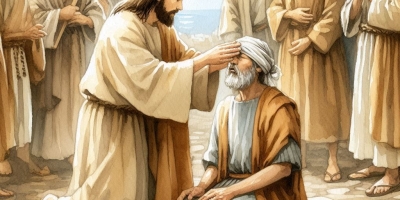
He healed people in his lifetime by laying hands on them and anointing them.
And today’s gospel makes it clear that Jesus empowered his disciples to continue his ministry of healing. The Gospel says of them, “They . . . rubbed olive oil on many sick people and healed them.” Mark 6:13
In a similar way, the Letter of James instructs the early Christian community to present themselves for healing, saying:
“Are any among you sick? They should send for the church elders, who will pray for them and rub olive oil on them in the name of the Lord. This prayer made in faith will heal the sick; the Lord will restore them to health, and the sins they have committed will be forgiven.” James 5:14–15
That’s exactly what the young Vietnam soldier describes so beautifully in his letter. He describes the remarkable healing of mind, body, and soul that was brought about by the sacrament of the Anointing of the Sick.
If we were to put into the simplest terms what this sacrament is all about, we might express it this way:
It is a continuation in modern times of the healing ministry
that Jesus began in gospel times. Just as Jesus healed people in his times by the physical actions of his physical body,
so Jesus continues to heal people today through the liturgical actions of his mystical body, the Church.
In other words, the Jesus who healed people in gospel times is the same Jesus who heals people today. The only difference is the manner in which Jesus heals them.
In gospel times, Jesus healed people by means of his earthly body. He touched them directly with his earthly hands.
Today, Jesus heals people by means of his risen body,
his mystical body, the Church.
He touches them indirectly through the hands of the priest.
And when he does, they experience the same kind of healing that people in gospel times experienced.
For example,
some experience a full or partial physical healing,
like the one the Vietnam veteran experienced. Others experience a mental healing that results in a peace of mind, like the peace that the soldier experienced. Still others experience a spiritual healing that results in a soul-stirring experience of God’s love and forgiveness,
like the forgiveness that the soldier experienced.
In other words, the healing of this marvelous sacrament is not confined to physical healing only.
In fact, the most tangible healing experienced might not be physical, but mental or spiritual.
And so if we are suffering from serious illness, or if we are suffering from advanced age, or if we are preparing for surgery for some serious ailment and have not yet been anointed, then today’s gospel invites us to request it.
Or if we have a family member or a friend suffering from one of these conditions, then today’s gospel invites us to invite them to receive this sacrament.
And if we accept Jesus’ invitation, then we too can hope for some tangible physical, mental, or spiritual healing, as people in gospel times experienced and as the Vietnam soldier experienced.
This is the beautiful message of today’s gospel. This is the good news that Jesus speaks to each of us today. This is the great mystery we celebrate in this liturgy.
What Jesus did for countless people in gospel times he also wants to do for us in our times—if we but let him.
Series III
15th Sunday of the Year
Amos 7:12–15, Ephesians 1:3–10, Mark 6:7–13
Roos’s pilgrimage
Preach and heal by your example.
Jesus said, “Don’t take anything with you . . . no bread . . .
no beggar’s bag . . . no money.” Mark 6:8
When Jesus sent his disciples out to preach and to heal,
he gave them this unusual instruction:
“Don’t take anything with you.”
Why did Jesus tell his disciples not to take anything with them, but to beg for everything?
Would Jesus give this same instruction to modern disciples if he were living in modern times?
What would happen if he did? How would people react if such a disciple showed up asking for food and lodging?
And even if people did give him food and lodging, how would he go about inviting his hosts to repent their sins and be healed—at least spiritually?
Some years ago, a young Jesuit priest, Richard Roos, wondered about these very questions. He decided to find the answers to them.
He got permission from his superiors to spend the 40 days of Lent making an 800-mile walking pilgrimage from San Diego to San Francisco. Early Christians made such pilgrimages
for various reasons—for example,
to express trust in God,
to deepen faith in people’s goodness,
to experience what it is like to be poor.
And so he set out following the old Spanish mission trail—
now a highway—that the early missionaries followed in evangelizing California in the 1700s.
Father Roos walked through sunshine, rain, and high winds.
He walked and walked, day after day, in spite of aching legs and blistered feet—just as the early missionaries did.
There was one difference, however. He identified himself only as a Christian on a Lenten pilgrimage.
What answers did he get to his questions? He writes:
Every afternoon at two or three o’clock I’d begin to feel a growing anxiety about where I would wind up spending the night. . . .
And of course, I felt the powerlessness of poverty.
When you go to a door . . .
and ask for food and lodging . . .
you find yourself feeling very humble.
You’ve just handed over the whole deck to the other person,
and it’s their deal. You have no rights or power.
How did people react to him when Father Roos showed up? He writes:
I was never treated harshly or unkindly. The people who hosted me were of all denominations of Christianity and even no religion at all. All were fascinated by the concept of a pilgrimage.
He concluded his report with an unexpected observation.
It relates directly to how he preached the Gospel. He writes:
Generally, I found that my presence and our conversation
gave or strengthened them in their hope in God and in the goodness of people.
I don’t know Father Roos personally. But I do know from what he writes that he is a prayerful person with a deep faith and a deep trust in God and in people.
Ithink it is right here that we have the answer to how he preached the Gospel on his pilgrimage.
He did it by his faith and his example. It was this faith and this example that came through when he talked with people.
In other words, he did not preach the Gospel by words.
He preached by a more powerful way: by his presence, his faith, and his example.
Some years ago, a number of young Christians were attending an international summer camp. They came from many nations around the world. One project assigned them was to come up with effective ways to preach the Gospel in our modern world.
After the young people talked about using television, radio,
rock concerts, and shopping malls, an African girl said something that touched the heart of everyone. She said:
When Christians in my country think a pagan village is ready for Christianity, they don’t send books or missionaries.
They send a good Christian family. The example of the family converts the village.
And that brings us to an application of today’s Gospel to each and every one of us here.
Jesus wants us to preach the Gospel today. He wants us to do it the way Father Roos did it, but with one exception.
He does not want us to do it on a Lenten pilgrimage.
He wants us to do it in our homes, in our work places,
and in our communities.
He wants us to do it the way the African girl suggested.
He wants us to do it by living as prayerful people with a deep faith in God and in people.
He wants us to do it by our presence and by our example, more than by our words.
And if we do it in this manner, not only will we strengthen
the faith of those around us, but we will also invite them to imitate our own faith and prayerfulness.
The poet Edgar Guest had it right when he said years ago:
It is all in vain to preach the truth, To the eager ears of trusting youth. . . .
Fine words may grace the advice you give, But youth will learn from the way you live.
And a Brahman in India had it right when he said to a Christian missionary:
If you Christians in India, in Britain, or in America were like your Bible, you would conquer India in five years.
Let us close with this prayer of Cardinal Newman. It says it all:
Lord Jesus, help me to spread your fragrance everywhere I go. Flood my soul with your spirit and life. Penetrate my whole being.
Shine through me and be so in me that every soul I come in contact with may feel your presence. . . .
None of it will be mine, all of it will be yours shining on others through me.
Let me praise you in the way that you love best . . .
without preaching by word, but by my example.